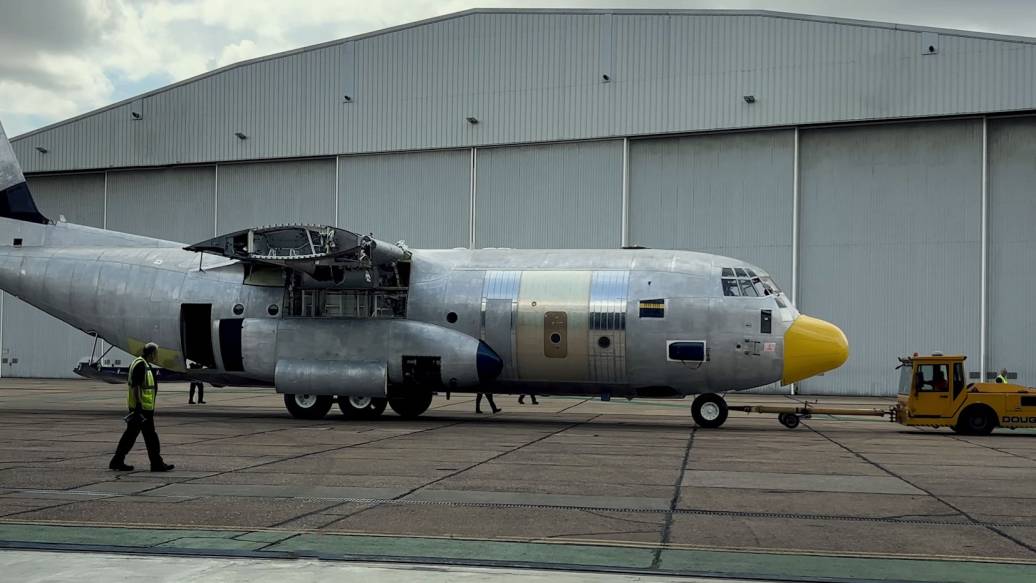
Installing a Lockheed Martin enhanced service life centre wing box can extend the useful life of a C-130 Hercules by more than 20 years.
But fitting a complex, heavy 11-metre structure to a decades-old airframe with a unique service history is not a straightforward task. To achieve a perfect fit, the installation demands extensive preparation, careful handling and exceptionally accurate alignment.
Our latest video shows how Marshall Aerospace carries out this highly specialised process at its Cambridge facility, featuring Fat Albert, the US Navy Blue Angels' C-130J support aircraft.
Preparing the new structure
The process begins well before the new centre wing box is lifted into place.
Delivered from Lockheed Martin as a bare structural assembly, the centre wing box must first undergo “dressing”, which involves installing wiring, pipework and other essential components.
This preparatory work takes thousands of hours and adds more than 1.5 tonnes to the structure.
At the same time, engineers inspect the exposed interfacing structures on the aircraft, checking connecting surfaces and attachment points for defects or distortion.
Any necessary repairs are completed before installation begins, ensuring the fuselage is ready to accommodate the new assembly.
Achieving the perfect alignment
With preparation complete, the centre wing box is lifted using an overhead crane and carefully lowered towards its intended position.
Engineers then conduct laser alignment surveys, known as “laser shoots”, to check its position against established structural reference points.
These measurements are exceptionally precise, with some tolerances as strict as 0.001 inches (0.025mm) – less than the width of a human hair.
Once the initial alignment has been confirmed, the centre wing box is raised slightly to allow sealant to be applied to the adjoining surfaces. It is then lowered back into place, with the sealant requiring up to 48 hours to cure.
Further laser surveys verify that the structure remains correctly positioned and within the required tolerances before work progresses.
Making the connection
The next stage is to permanently secure the centre wing box to the fuselage.
Using specialised “speed-and-feed” tooling, technicians drill precision holes through both structures, creating the attachment points for the fasteners and rivets that will hold the assembly together.
Each connection contributes to the structural integrity of the aircraft, allowing the centre wing box to withstand the significant stresses encountered during operational flying.
With the main installation complete, external covering panels are fitted, restoring the aircraft's aerodynamic profile and protecting the newly installed structure.
Jacks are also positioned to allow the underbelly support trestles to be removed, while the nose landing gear is refitted so the aircraft can be moved from the installation area.
Towards a return to service
The successful installation marks an important milestone in the centre wing box replacement programme, paving the way for the remaining major components to be reassembled.
Further systems integration, inspections and testing will follow before the aircraft can return to service.
As the world's first Lockheed Martin-authorised Centre of Excellence for C-130 centre wing box replacements, Marshall Aerospace has developed dedicated facilities, tooling and processes to support this demanding work, helping operators extend the service lives of their Hercules fleets.
LEARN MORE ABOUT CENTRE WING BOX INSTALLATION AT MARSHALL AEROSPACE